
“Jean Bodin’s Demonic Constitutionalism: Sovereignty, Natural Law, and Political Theology”
with Gio Maria Tessarolo
American Political Science Review, 2026
Illustrated miniature from the 1559 manuscript of Pierre Boaistuau’s Histoire prodigieuses. Wellcome Collection, MS 136.
It is commonly assumed that the “classical” concept of sovereignty, bequeathed by Jean Bodin, stands in tension with fundamental commitments of liberal modernity, including cosmopolitanism and the aspiration to establish a global legal order. We argue, in contrast, that Bodin’s theory of sovereignty presupposes a universal legal order that imposes binding and enforceable constraints on sovereigns. To substantiate this claim, we examine Bodin’s curious assertion that God, the sovereign ruler of the cosmos, employs a celestial government or administration of angels and demons to enforce His laws. By situating Bodin’s earlier political works alongside his later religious and philosophical writings, we demonstrate that his political thought was neither “absolutist” nor “constitutionalist,” in the ordinary sense of those terms; rather, he was a theorist of what we propose to call “demonic constitutionalism.”
“Machiavelli Against Sovereignty: Emergency Powers and the Decemvirate”
Political Theory, 2024
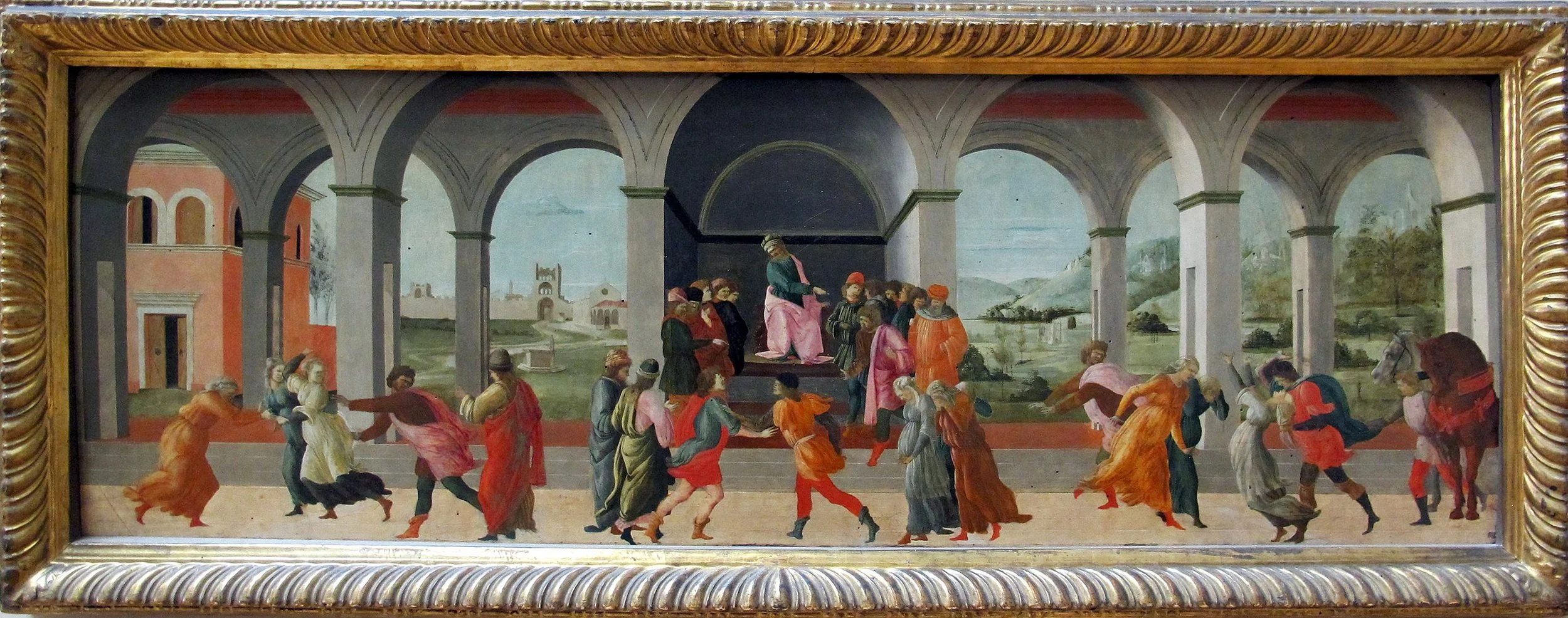
Filippino Lippi, Storie di virginia, c. 1470/80. Oil on wood panel. Musée du Louvre, Paris.
This article argues that Machiavelli’s chapters on the Decemvirate (D I.35, I.40-45) advance an internal critique of the juridical discourse of sovereignty. I first contextualize these chapters in relation to several of Machiavelli’s potential sources, including Livy’s Ab urbe condita, Dionysius of Halicarnassus’s Roman Antiquities, and the antiquarian writings of Andrea Fiocchi and Giulio Pomponio Leto. I then analyze Machiavelli’s claim that the decemvirs held “absolute authority” (autorità assoluta)—an authority that was unconstrained by either laws or countervailing magistrates. I proceed to argue that Machiavelli’s account of the decemvirs’ election contains a web of allusions to the lex regia, the “royal law” by which the Roman people were thought to have conveyed their sovereign power to an emperor. By modeling the decemvirs’ election on the lex regia, Machiavelli reveals the political limitations of the doctrine of popular sovereignty; moreover, he illustrates that even “free and fair” elections can easily give rise to tyranny.

René Boyvin, Portrait of Aristotle (Illustrium philosophorum et poetarum effigies), 1566. Engraving. Rijksmuseum, Amsterdam.
Recent scholarship has placed the concept of friendship at the center of Aristotle’s political thought. However, relatively little attention has been given to Aristotle’s claim that political friendship is “based on equality.” This article first explicates this claim as it appears in the Eudemian Ethics, where Aristotle asserts that the paradigmatic form of political friendship is based on “arithmetic” rather than “proportional” equality. Second, it shows that this “egalitarian” conception of political friendship is fully consistent with the Nicomachean Ethics and Politics — and in doing so, challenges a recent argument that the Eudemian Ethics was not genuinely written by Aristotle. Third, it argues that Aristotle’s “egalitarian” conception of political friendship motivates his advocacy of various economic arrangements and practices throughout the Politics, including but not limited to the “common use” of property.
“Machiavelli’s Principio: Political Renewal and Innovation in the Discourses on Livy”
The Review of Politics, 2020
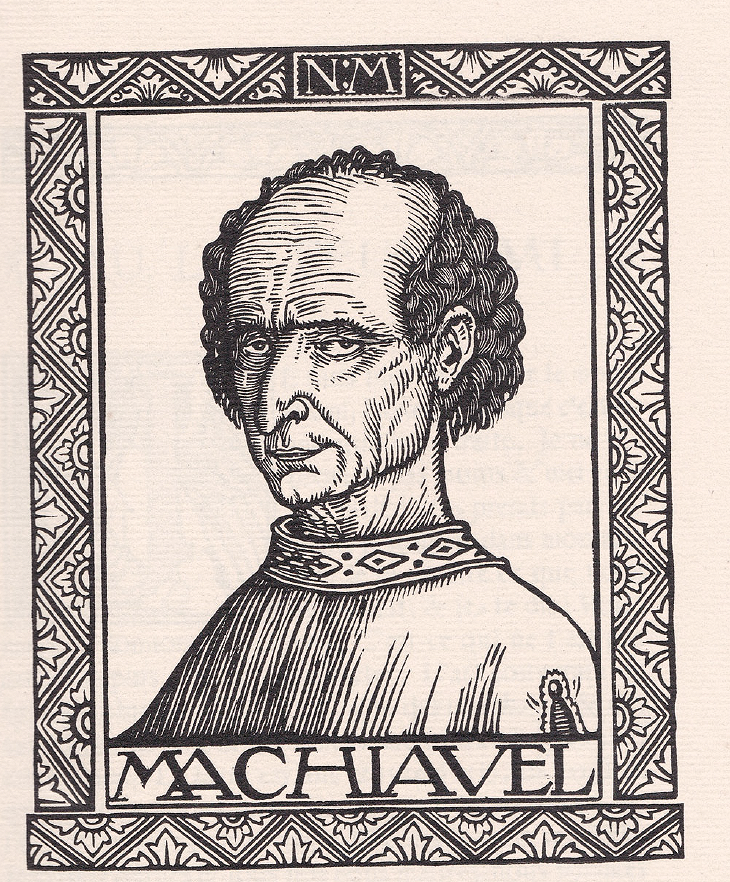
Louis Jou (1881–1968), portrait of Niccolò Machiavelli. Woodcut. Granger Collection.
Although Machiavelli argues that “return to first principles” is a necessary and perhaps even sufficient condition for counteracting political corruption, few scholars have engaged in a sustained textual analysis of Discourses III.1, the chapter in which he outlines the meaning of this enigmatic concept. Reassessing Machiavelli’s exempla in this chapter will reveal that return to first principles consists in the revival of the ethos of innovation and public-spiritedness that accompanies every successful political founding. This process of renewal entails reviving the psychological forces that initially guide human beings to establish new political orders, including fear of violent death and longing for glory. Existing interpretations of D III.1 have tended to emphasize renewal through fear-invoking punishment, neglecting Machiavelli’s examples of renewal through exemplary acts of civic virtue. A careful analysis of instruments and agents of return to first principles will illustrate how both spectacular punishment and virtuous acts of self-sacrifice converge to counteract corruption and foster political innovation.